LucasFilm, the owner of the iconic Star Wars movie franchise, has scored an early win in a lawsuit against the game developer of Sabacc, a lesser-known element of the fictional Star Wars universe. According to Star Wars lore (specifically, the 1980 novelization of The Empire Strikes Back), Han Solo won the Millennium Falcon from Lando Calrissian through a winning hand in a game called Sabacc, a fictional betting game involving a special deck of cards where the goal is to finish with a hand as close as possible to positive or negative 23.
In 2016, London-based Ren Ventures obtained a U.S. federal trademark registration for Sabacc in connection with mobile games, claiming a first use date of November 2015. Although LucasFilm is well-known to be an aggressive enforcer of its extensive Star Wars-related trademarks (e.g., Jedi, The Force, Darth Vader, etc.), it’s likely that the Sabacc application slipped through LucasFilm’s trademark monitoring measures, because LucasFilm never secured a federal trademark registration for the term. Notwithstanding the absence of its own federal registration, LucasFilm filed both a Petition to Cancel the Sabacc registration with the Trademark Trial and Appeal Board, and a lawsuit in California Federal District Court alleging trademark infringement. However, without a federal registration and its accompanying presumptions of validity, LucasFilm has the added challenge of establishing its common law rights to Sabacc in order to prevail on its claims.
Ren Ventures filed a Motion to Dismiss the lawsuit, alleging that Sabacc is merely a fictional card game in the Star Wars fantasy universe that does not function as a protectable trademark for real-world goods or services. In order to be protectable, trademarks must function as source identifiers that allow consumers to distinguish between products and services in the marketplace. Ren Ventures argued that the mere mention of the fictional game Sabacc in Star Wars lore is insufficient grounds for LucasFilm to claim protectable trademark rights in the term.
Although the lawsuit is still in the early stages, the judge appears to be leaning in favor of LucasFilm. In denying Ren Ventures’ Motion to Dismiss, the judge noted that even if Sabacc did not function as a trademark for a stand-alone game product, it could function as a source identifier for the overall Star Wars franchise. The judge concluded that because Ren Ventures had used Sabacc with the intent that consumers associate the unlicensed game with licensed Star Wars products, LucasFilm had stated a viable claim for trademark infringement for purposes of defeating the Motion to Dismiss.
In response to Ren Ventures’ argument that LucasFilm’s limited use of Sabacc was not continuous enough to establish trademark rights, the judge first noted that the issue involved a factual inquiry that could not be decided on a Motion to Dismiss (which is resolved based solely on the allegations made in the pleadings). The only alleged usage of Sabacc claimed by LucasFilm was in connection with a one-time release of playing cards that were not offered as a stand-alone game, but sold in conjunction with a Star Wars fan book entitled Crisis on Cloud City (see below). The judge noted that LucasFilm would not be required to establish at trial that it had released a new Sabacc card game each year in order to prevail on its claims. Instead, LucasFilm would only need to show that a prior release of the game had remained popular, and continued to circulate years after the initial release date.
It remains to be seen if the case will proceed to trial, but at least at this early stage, the court appears to be leaning in favor of LucasFilm on the merits of its claims.
The case citation is LucasFilm, LTD., LLC, et. al. v. Ren Ventures, LTD., et al., Case No. 17-CV-07249-RS
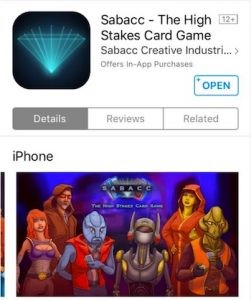
Below is a screen shot of Ren Ventures’ mobile app game for Sabacc:
From page 8 of the Complaint, a photo of the cover of the book Crisis on Cloud City, featuring an advertisement in the top right corner for “Sabacc Card Game Inside!”

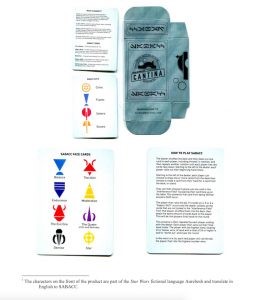
Attached as Appendix A to the Complaint is a picture of the deck of Sabacc cards featured in the book. However, the term Sabacc does not appear anywhere on the product packaging - instead, the cards are labeled with characters written in the Star Wars fictional language Aurebesh (which allegedly, translates into English as Sabacc):
 Heather Morado